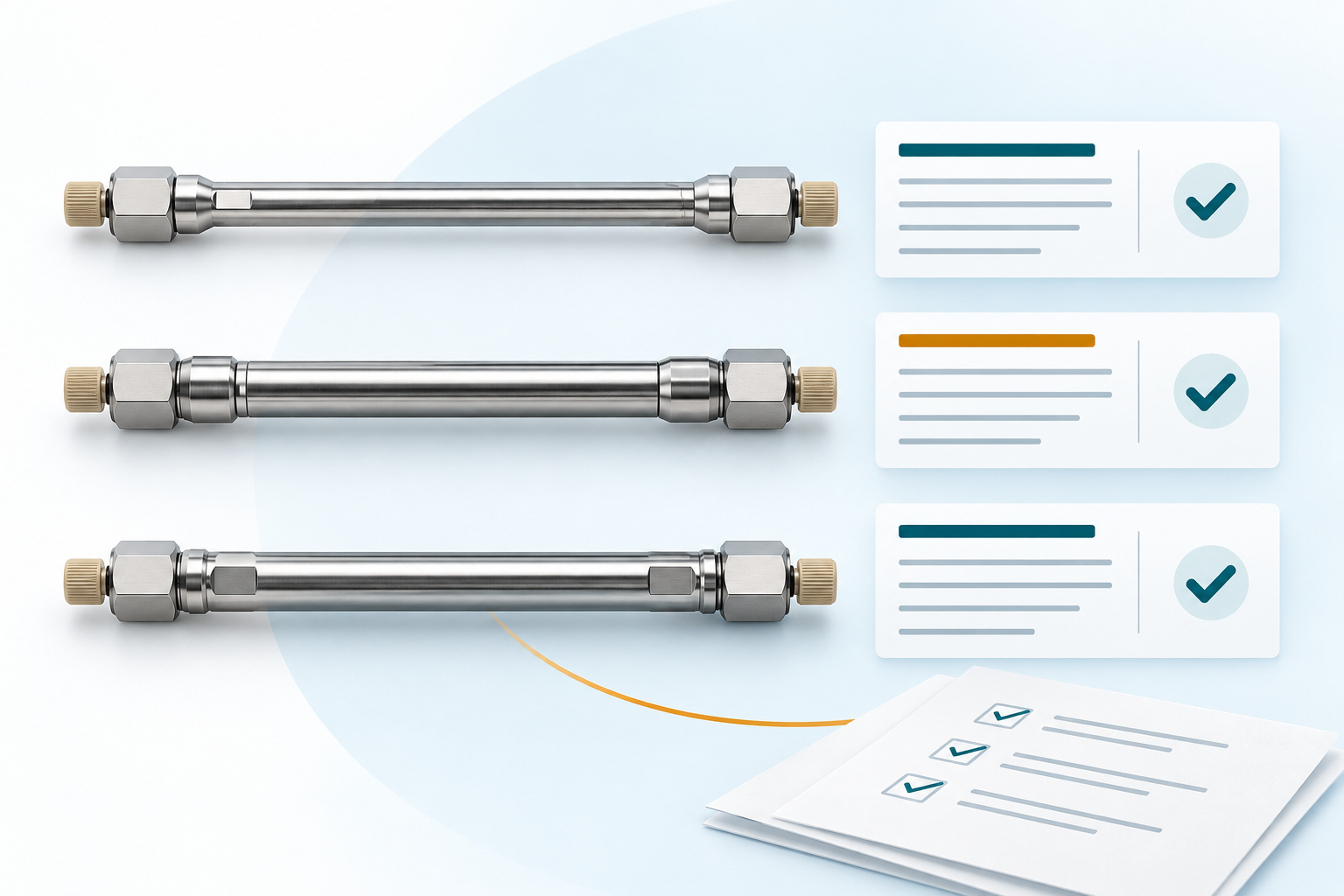
Illustration of a specification-based column shortlist.
An HPLC column enquiry is easier to answer when the exact requirement is clear. Before requesting a quote, identify whether you need the same part again, a documented alternative or a column for a new method. Those are different purchasing questions, even when the first search term is the same.
This guide shows how to build a useful shortlist with the information available in HPLCmart. It is a purchasing workflow, not a recommendation that any two columns will produce the same separation.
Find the manufacturer’s part number on the column label, the previous order or the method record. Search for that exact reference in the HPLCmart catalogue, then open the product details and check the full description. A familiar family name alone may refer to several variants.
Keep the manufacturer, product family and part number together in your notes. If you cannot find an exact match, say so in the enquiry rather than treating a similar search result as the same product.
Write down the chromatography mode, the intended application and any specifications already fixed by your method or instrument. Use the catalogue filters to narrow the available information, then inspect the individual products. Leave a field open when you do not know the requirement; an uncertain value entered as a requirement can hide useful candidates.
HPLCmart’s detailed search includes column length, internal diameter, particle size and pore size alongside vendor, brand and other specification fields. Record the units with every value. In particular, particle size and pore size are separate fields; do not copy a value from one into the other.
Keep a small comparison sheet for the candidates you are actually considering. Use the product details as the starting reference and mark missing information as a question for the supplier.
For example, if your method names a particular part number, two columns with the same dimensions should still remain separate candidates until the relevant product information has been checked. Do not describe one as an equivalent replacement simply because the visible dimensions match.
Use current documentation for the exact product to confirm operating limits and suitability for the intended use. Catalogue filters help organise a search; they do not establish method compatibility or guarantee a result.
Manufacturer selection guides can help structure the technical discussion. The Agilent HPLC Column Selection Guide, for example, distinguishes stationary phase, particle and pore characteristics and column dimensions. It is an Agilent reference, not evidence that products from different manufacturers are interchangeable. Ask the relevant supplier about any unresolved product-specific question.
Open the exact product’s enquiry or quotation option and include the information needed to identify your request. The most useful starting details are the part number, quantity, delivery country and whether you need an exact replacement or want advice on an alternative. Add the required dimensions or other fixed specifications if the product identity is still uncertain.
Keep technical suitability, availability and price as separate questions. A quotation answers the commercial request; any unresolved method or product requirements still need an appropriate technical answer.
Retain the product link, the specification reference and the supplier’s response with the shortlist. Record any open questions before placing an order. That makes the decision easier to explain to colleagues and prevents a similar product name from becoming an accidental substitution.
Start with the catalogue to find a known part number or narrow a new shortlist. For a general question that does not relate to an identified product, use the HPLCmart contact page.
Reach thousands of researchers worldwide. Fill in your details and our team will contact you shortly.